Streets for people Levenshulme & Burnage are very disappointed to learn that Manchester City Council are proposing yet another change to the Active Neighbourhood plans which will negatively affect residents’ safety.
We recently learned from councillors last that they intend to remove the proposed filter at the western end of Manor Road, which, in the last consultation, ending in January this year, was to replace the temporary filter site at the eastern end of Manor Road – which was recently removed following the end of the trial – between the Greenbank parks.
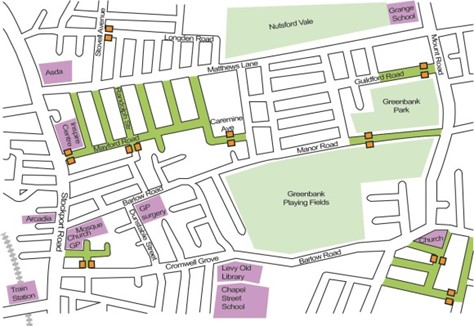
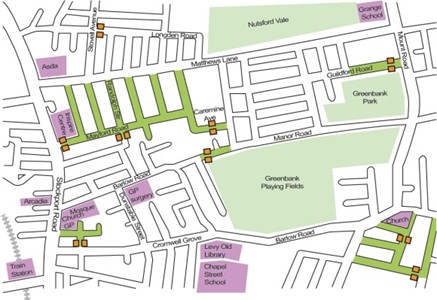
In the maps below, in green, you can see the sections of the road that these different interventions would make safe by removing through motor vehicle traffic. As can be seen, the relocation of the Manor Road filter from East (Map 1) to West (Map 2) would have not made much difference to active travel – the safe roads for walking and cycling would still have been few and far between. Crucially, they would have also been disconnected from each other – you need connected safe roads for connected journeys, which is the only way we’ll reduce car use and pollution in the area, by increasing walking and cycling for shorter journeys.
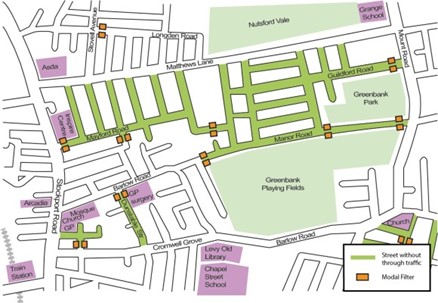
Earlier this year, we learned through a Freedom of Information request response that Levenshulme councillors had personally rejected the council’s Highways team’s proposal for additional filters, one at the western end of Manor Road and one on Dunstable Street, despite Highways highlighting the benefits of the move and the popularity of the idea in consultations. As can be seen in the map below, this would have made the whole of Manor Road, and surrounding streets, safe for active travel – 1.7km of our roads in total – creating a safe route for hundreds of residents from their properties to community amenities and bus stops on the A6.
Unfortunately, at a public event, we were unable to get an intelligible answer from councillors as to why they had intervened to reject more ambitious plans. Fast forward to June 2022, and Manchester City Council announced that all of the existing active neighbourhood trial filers will soon be made permanent, with the Manor Road filter being moved from East to West, as was proposed in latest the consultation. See Image 1, below.
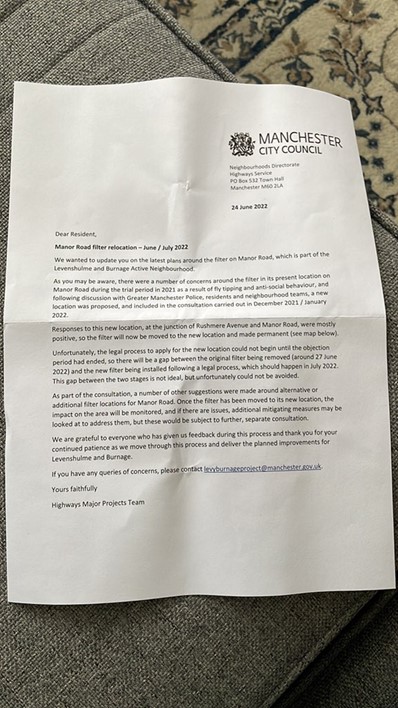
The letter states that the consultation found that the new location at the west end of Manor Road received ‘mostly positive’ feedback, meaning that they would install the filter in July.
At around this time, we learned that the councillors had had a change of heart in terms of the Manor Road situation. They would now campaign for an extra filter at the eastern end of Manor Road, as we, and a huge number of residents in the immediate area, had been campaigning for them to do. Should their campaign be successful, we were led to believe that, combined with the new, western end filter, this would create a situation where filters at both the eastern and western ends of Manor Road would eventually be in place, and so the best situation outlined in Map 3, above, would be achieved.
Finally, we thought, the councillors were starting to see sense: filters only work in conjunction to make safe streets for active travel. Isolated, individual filters don’t achieve that. As such, we celebrated their new-found bravery – albeit so far only on this one issue – as a step towards supporting more ambition in local transport policy.
But we were wrong. As it turns out from our recent meeting, they are only campaigning for the eastern Manor Road filter, and agree with MCC’s as yet unannounced plans to withdraw the western end filter.
While it is good that the councillors want to see the eastern end filter reinstated, we are disappointed with their support for MCC for withdrawing the western end filter, especially as it has received significant support in a series of community consultations, and was on the cusp of being installed.
Even if the councillors are successful in getting the eastern end filter reinstated, this is going to cause huge problems for residents on Manor Road, and the roads between Manor Road and Matthews Lane. As we saw during the filter trial, the eastern end filter on its own did not prevent rat running between the A6 to Matthews Lane, with fast cars speeding down the western end of Manor Road, and then down one of the roads connecting Manor Road with Matthews Lane – Lonsdale Road, Hornbeam Road and Audley Road.
However, the final project consultation included a 20mph speed restriction, lane narrowing and speed tables for Matthews Lane (see Map 4, below). These interventions are very welcome on a road blighted by speeding. However, the plans include no speed reduction measures for Manor, Lonsdale, Hornbeam and Audley roads as well. So there is a great risk that these streets, without the western end of Manor Road filter, will see a marked increase in traffic moving at high speed, to avoid what will be a much slower Matthews Lane. In fact, these narrow residential roads could easily become the ‘main route’ for through traffic between the A6 and Mount Road for sat nav systems – a terrible situation for residents and anyone trying to move around the community without a car.

Councillors Zahid Hussain and Basat Sheikh explained that, although the western end of Manor Road filter had been popular in the public consultation, the council had ‘forgot’ or ‘didn’t know’, that Madina Mosque, which is located at the western end of Barlow Road, had organised and submitted petition against the filter during the consultation process.
Streets for People very much welcome the council’s belated engagement with the mosque, and believe that the council should have been more pro-active and responsive to the mosque’s queries and concerns throughout the consultation process. As yet, we are not clear on the exact nature of the concerns the mosque has raised (having only heard about it second hand), and are very keen to engage with them to learn more.
Moreover, we feel that there needs to be a plan which improves road conditions for non-car users in the area, while maintaining motor vehicle access to the mosque for those that need it. We are certain that, with proper discussion between the city council, the mosque, and other community groups, a solution can be found that meets these objectives.
Too many times, we’ve heard from the council and councillors why this or that aspect of the scheme won’t work, or is too unpopular. But the 70% approval by residents for the scheme in the latest consultation is just the latest example of consultations about the scheme showing massive public support for much better walking and cycling routes in our community. Within that, different parts of our community and their specific needs must be addressed with care and sensitivity. But none of us are benefiting from the pollution, danger, and social inequalities our high traffic neighbourhood creates. Working together, our community can turn our streets from prioritising cars to prioritising people. We just need the will to lead that process from our political leaders.
 Streets for People - Levenshulme and Burnage